This is truly incredible. Homeowners have lost more than $5 trillion in housing wealth. There is a very well established wealth effect whereby $1 of housing wealth is estimated as leading to 5 to 6 cents of annual consumption. This implies that the loss of wealth to date would cause consumption to fall by $250 billion to $300 billion annually (1.7 percent to 2.0 percent of GDP). If you add in the loss of around $6 trillion in stock wealth, with an estimated wealth effect of 3-4 cents on the dollar, then you get an additional decline of $180 billion to $240 billion in annual consumption (1.2 percent to 1.6 percent of GDP).
These are huge falls in consumption that would lead to a very serious recession, like the one we are seeing. This would be predicted even if all our banks were fully solvent and in top flight financial shape. Even the soundest bank does not make loans to borrowers who it does not think can pay the loans back (except during times of irrational exuberance).
Wednesday, November 12, 2008
Wealth Effect
I seldom agree with Dean Baker, but here he has a good point.


Monday, November 10, 2008
Visualizing the Election
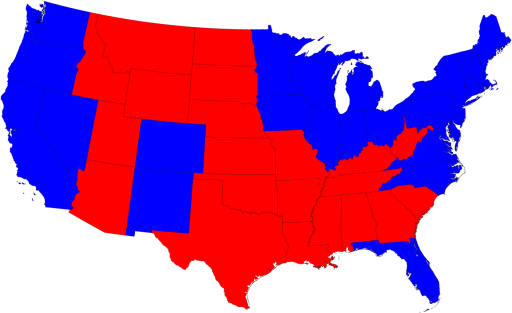
CNN and other news outlets would have you believe this is still a divided country with red states and blue states.

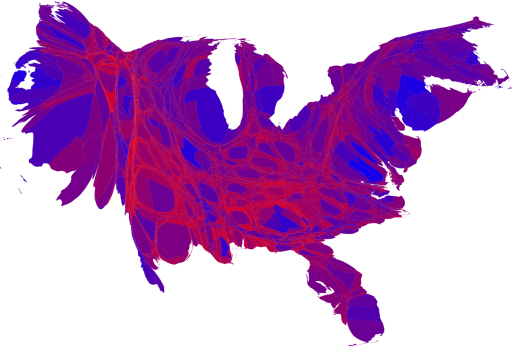
But a better visualization would shade the areas based not upon who won the state, but by the degree to which they won the state. And the states themselves shouldn't be represented as a function of their geographic size, but rather the size of their population. Here we have just such a picture, and its clear, we are all purple now. More can be found here.

But a better visualization would shade the areas based not upon who won the state, but by the degree to which they won the state. And the states themselves shouldn't be represented as a function of their geographic size, but rather the size of their population. Here we have just such a picture, and its clear, we are all purple now. More can be found here.
Sunday, October 19, 2008
Kondratieff Cycles?
A regular attendee emails:
My Response:
Just curious… Do you think that the current economic state is merely a “normal” manifestation of the Kondratieff wave? I was first exposed to the theory in 1989 in a marketing seminar as the economy was ramping up toward the unforeseen, at that time, DOT BOMB in 2001. Just thought it might be something interesting to weave into your next presentation. Any thoughts?
My Response:
I am familiar with Kondratieff waves, but I must say I’m pretty skeptical. That our economy - and capitalism in general - is prone to cycles is pretty clear. That those cycles have a regular periodicity is not so clear. In order for me to find any plausibility in theories which claim to have identified some regularity in the cycle it would have to have good predictive power, with fairly sharp predictions. The Kondratieff cycle hypothesis does haven’t very sharp predictions. What you really have is an ex-post justification for the data that we see, and even those that ascribe to the theory, don’t really agree on their identification of the phases of the cycle, making it a less plausible idea. At the end of the day cycles are a function of the collective, yet often idiosyncratic behavior of individuals. I have a hard time believing there is any mechanism that causes these things to occur with predictable regularity. I think you’ll find that this idea appeals to the econo-physicists much more than to any social scientist-economist.
Tuesday, September 16, 2008
Tax Math
Higher taxes are most likely in our future, regardless of who we elect:
Douglas Holtz-Eakin, a former Director of the Congressional Budget Office and current chief McCain economic advisor, is an honest man--which means he's something of a liability on the Straight Talk Express. A few months ago, he admitted to my colleague, Michael Scherer, that Barack Obama's economic plan would reduce taxes for most people. And now, in a forthcoming book by Fortune columnist Matt Miller, he makes it clear that the next President is going to have to raise taxes.And the futures market is also betting on rising taxes according to Mankiw.
"If you do nothing on the spending side, you're going to have to raise taxes whether you're a Republican, a Democrat or a Martian," he tells Miller...and then he immediately makes it clear that the "spending side" part of the argument is nothing more than a political fig-leaf.
The top income tax rate is now 35 percent. According to the betting at Intrade, the probability that the top income tax rate in 2011 will exceed 38 percent is 0.87. Call this P(tax hike).
Barack Obama has made such a tax hike part of his campaign promises, and there is no reason to think the Congress won't deliver for him. So let's assume Obama is certain to get the tax hike if he wins. That is, P(tax hike / Obama) = 1.0. (If this assumption is wrong, and this conditional probability is less than one, then my conclusion below would be even stronger.)
According to Intrade, the probability of Obama being the next president is 0.53. Call this P(Obama). And P(McCain) = 0.47.
Now we can calculate the probability of a tax hike conditional on McCain winning. It comes from the formula
P(tax hike)
= P(tax hike/Obama) P(Obama) + P(tax hike/McCain) P(McCain),
and plugging in the above numbers. It tells us that
P(tax hike / McCain) = 0.74.
Saturday, August 30, 2008
Foreclosure Filing Rate and The Unemployment Rate
The graph below shows the county's unemployment rate, and the foreclosure filing rate, with the size of the bubbles proportional to the population of the county. A larger version can be found here.
Saturday, August 23, 2008
Property Taxes
We recently finished the semi-annual consumer sentiment survey for the 7 Rivers Region. The upcoming September meeting concerns the Wisconsin Way initiative. In preparation we asked our participants some of the questions that have been asked around the state. In particular we asked:
When you think about the property taxes you or your landlord pay on the home in which you live and the services you receive for those taxes would you say property taxes in Wisconsin (or your state of residence) are much too high, somewhat too high, about right, somewhat too low or much too low?
I've joined the following answers and created a word cloud.
a. Much too high
b. Somewhat too high
c. About right
d. Somewhat too low
e. Much too low
f. Other
The fact that you can not find Much Too Low or Somewhat Too Low in the graphic is not a mistake.

When you think about the property taxes you or your landlord pay on the home in which you live and the services you receive for those taxes would you say property taxes in Wisconsin (or your state of residence) are much too high, somewhat too high, about right, somewhat too low or much too low?
I've joined the following answers and created a word cloud.
a. Much too high
b. Somewhat too high
c. About right
d. Somewhat too low
e. Much too low
f. Other
The fact that you can not find Much Too Low or Somewhat Too Low in the graphic is not a mistake.

Monday, June 23, 2008
Hollywood Subsidies
La Crosse was initially in the running to become one of the locations for the new Johnny Depp "Public Enemies" movie. Wisconsin was chosen for several reasons, one of which was probably the newly passed tax considerations. Maybe we should look at the evidence and research done by other states. This headline says it all:
Rich stars pocket subsidies, state says
The analysis by the Department of Revenue this week estimated that at least half the film-industry payroll spending will go to out-of-town residents, mainly actors, directors, and producers commanding salaries of more than $1 million each. The Revenue Department assumes they will spend only a fraction of their paychecks in Massachusetts, limiting the benefits to the local economy.
The Revenue Department noted its analysis is consistent with a 2005 report on Louisiana's film tax subsidies, which estimated 60 percent of spending eligible for tax credits would go out-of-state. And when The Providence Journal reviewed records for a Wesley Snipes film subsidized by Rhode Island, it found just $1.9 million of the $11 million in production expenses went to local residents and vendors - less than the $2.65 million in tax credits issued to support the 2006 movie, "Hard Luck."
But in this week's report, the Revenue Department found the subsidies probably wouldn't generate enough money in income taxes and other revenue to offset the cost of the incentives, forcing the state to cut other government spending. Assuming $100 million a year in incentive spending, the state said it would only be able to recoup $18 million to $23 million in other tax revenue.
Subscribe to:
Posts (Atom)