
Monday, August 6, 2012
Feb 2012 Consumer Sentiment
Turning
to the original 5 questions in the consumer sentiment survey we again see the 7
rivers region data mirrors the national data. The overall sentiment index
increased from 66.2 to 94.4, and the gains appear to have come – almost equally
– through both the current conditions index and the consumer expectations.


Monday, February 20, 2012
Consumer Sentiment Fall 2011
The first week of August I distributed via email the semi-annual consumer sentiment survey to 1466 past participants in programs related to the Seven Rivers region. I received 324 responses for an overall response rate of 22.1%. The graph and table below clearly show the precipitous drop off in both the regional and national indices. The overall consumer sentiment fell from
80.5 in early April to 66.2 in August, while the national index declined from 68.2 to 54.9. the decline can likely be attributed to recent weak economic data and the uncertainty created by the debt ceiling debate. The table below provides all the data since the inception of the regional survey. Although unlike the national index, we have not fallen below the February 2009 lows.


Wednesday, August 10, 2011
Consumer Sentiment Spring 2011
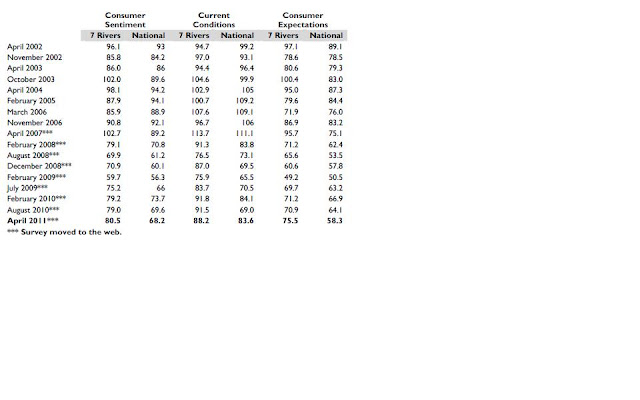
The first week of April I distributed via email the semi-annual consumer sentiment survey to 1466 past participants in programs related to the Seven Rivers region. I received 353 responses for an overall response rate of 24.1%. The table below provides all the data since the inception of the regional survey. We see from August of 2010 to April 2011 the regional overall consumer sentiment index increased slightly from 79.0 to 80.5 overall, while the national index fell slightly over the same period. The Expectations sub index has turned mildly more optimistic rising to 75.5 from 70.9, while the national expectations index over the same period actually fell.

Thursday, March 31, 2011
Consumer Sentiment: Fall 2010
The August 2010 data is below. We can see the Seven Rivers Region consumer sentiment index fell slightly from 79.2 to 79.0 while the national index fell more significantly from 73.7 to 69.6. The April 2011 data will be released at the Economics Indicators Breakfast May 4th.


Sunday, March 6, 2011
Dating the Recession
Tuesday, February 22, 2011
Wisconsin 2010-2011 General Fund Appropriations
This is data from Table 10 from Act 28.
This link which takes you to the "Many Eyes" website in order to have a bit more room to play around with it.
This link which takes you to the "Many Eyes" website in order to have a bit more room to play around with it.
Thursday, September 23, 2010
Wednesday, September 22, 2010
Friday, August 27, 2010


Thursday, August 12, 2010
Update: Consumer Sentiment
In February 1,344 Seven Rivers Region participants were again contacted to participate in the consumer sentiment survey. 301 of the participants responded. The over all index increased to 79.2 from 75.2.


Tuesday, April 13, 2010
Wednesday, March 3, 2010
Fewer New Cars
A permanent decline in new vehicle registrations?
MADISON, Wis. - New vehicle registrations in Wisconsin are nearly half of what they were in 2000.
Registrations dropped 46 percent - a hit that's felt well beyond the state's auto dealerships.
Thousands of jobs have disappeared as auto plants and their suppliers deal with the fractured auto industry.
The auto statistics service Cross-Sell shows the number of new vehicles registered in Wisconsin in 2009 was nearly 172,000 - down from nearly 320,000 in 2000.
Since 2000, 107 auto dealerships have closed in Wisconsin, including 56 in 2008 and 2009.
The Journal Sentinel reports state employment in auto parts manufacturing fell 44 percent from 2000 to 2009. Parts factories such as Tower Automotive and Delphi in Milwaukee and Lear and SSI in Rock County closed.
Friday, February 26, 2010
Economic Development Spam
Here is an email (read span) I recently received (here is a similar link):
Really? So If I travel to your state and spend 1,000 dollars that I would have spent in my own state, on something like home improvements, and you travel to my state and spend 1,000 you would have spent in your home state on home improvements, we will create jobs? Wow, that is literally the dumbest thing I have ever heard, its not even beggar-thy-neighbor. It creates ZERO net change in economic activity, thus it creates ZERO net jobs.Oh, but maybe this line gives us a hint as to who thinks its a good idea:
DPC Special Report & Video | Promoting Travel and Tourism Will Create Jobs
Hello All, I wanted to alert you to the fact that the DPC has released a one-pager on the Travel Promotion Act (link and full text below), outlining the significance in passing this importance piece of legislation. As the Senate continues to debate a series of bills in the coming weeks that will create jobs for the American people that need it most, as part of its jobs agenda, it is important to keep in mind that this bill is a jobs bill—as the U.S. Travel Association projects it will create nearly half a million jobs. Moreover, the Congressional Budget Office estimates it will reduce the federal deficit by $425million over the next decade. It is not often that we see both of these things accomplished, in one piece of legislation. I encourage you to take a look at this report, as it quite clearly lays out exactly what this bill will do. In addition, I have included a clip from Senator Dorgan, who has been very active on this issue. While speaking on the Senate floor, he focuses on the idea that by passing this bill and funding a national campaign that will promote travel to the U.S., it could ultimately strengthen America’s standing around the world—an idea that is truly tough to put a price tag on. As always,please be in touch if you would like to discuss in more detail. Many thanks.--Kati
Really? So If I travel to your state and spend 1,000 dollars that I would have spent in my own state, on something like home improvements, and you travel to my state and spend 1,000 you would have spent in your home state on home improvements, we will create jobs? Wow, that is literally the dumbest thing I have ever heard, its not even beggar-thy-neighbor. It creates ZERO net change in economic activity, thus it creates ZERO net jobs.Oh, but maybe this line gives us a hint as to who thinks its a good idea:
as the U.S. Travel Association projects it will create nearly half a million jobs...And they don't care about the half a million jobs which will be lost in the home improvement sector. The fetish with gross "job creation" needs to end. If we care about jobs it is about NET jobs.
Friday, February 19, 2010
Budget Data
Visualizations of the federal budget from various sources:
The Washington Post.
The New York Times.
The Wall Street Journal.
Update.
I missed:
The Guardian.
The Washington Post.
The New York Times.
The Wall Street Journal.
Update.
I missed:
The Guardian.
Tuesday, February 16, 2010
Update: Consumer Sentiment
In July I again conducted the consumer sentiment survey using a web based survey. 1,344 people received an invite to complete the survey. The group represents past participants in 7 Rivers Region economic development events, including the semi-annual indicators breakfast meetings. There were a total number of 294 responses for a response rate of 21.9%. Consumer Sentiment for both the region and the nation increased with most of the increase coming from the subset of questions which measure expectations. The regional consumer sentiment index rose from 59.7 in February to 75.2 in July, while the national index rose from 56.3 in February to 66 in July.


Keeping Them Honest
Both sides of the political aisle are prone to exaggeration and convenient amnesia. Recent discussions of Obama's plan to allow the Bush tax cuts to expire have included references to socialism. Below you will find the historical top marginal income tax rates, color coded by party. Another take is here. [Data Source].


Wednesday, January 13, 2010
Wednesday, October 28, 2009
The Debt
I'm often asked about the "problem" our debt represents. Below is a largely good video explaining who holds the debt and the "problem" it presents. One VERY important caveat. While the author gets the idea correct that what matters is publicly outstanding debt, since inter-government debt is merely a wash, he does not accurately address this same issue when talking about bonds as financial assets. Remember that a US government bond is an asset to the holder, but a liability to the tax payer. We care about our net position as tax payers. Also, from an economic perspective, bond holders and tax payers are not the same people, so there are distributional consequences to changes in the level of the debt. But with that said this might help somewhat.
Sunday, October 25, 2009
Great Questions
Pulled from Marginal Revolution:
What will result from the intersection of two possible trends: insistence on a greater equality in health care outcomes, and the development of new technologies -- some at the genetic level for the individual -- which will lead to a greater inequality of health care outcomes?
Wednesday, October 21, 2009

Subscribe to:
Posts (Atom)